


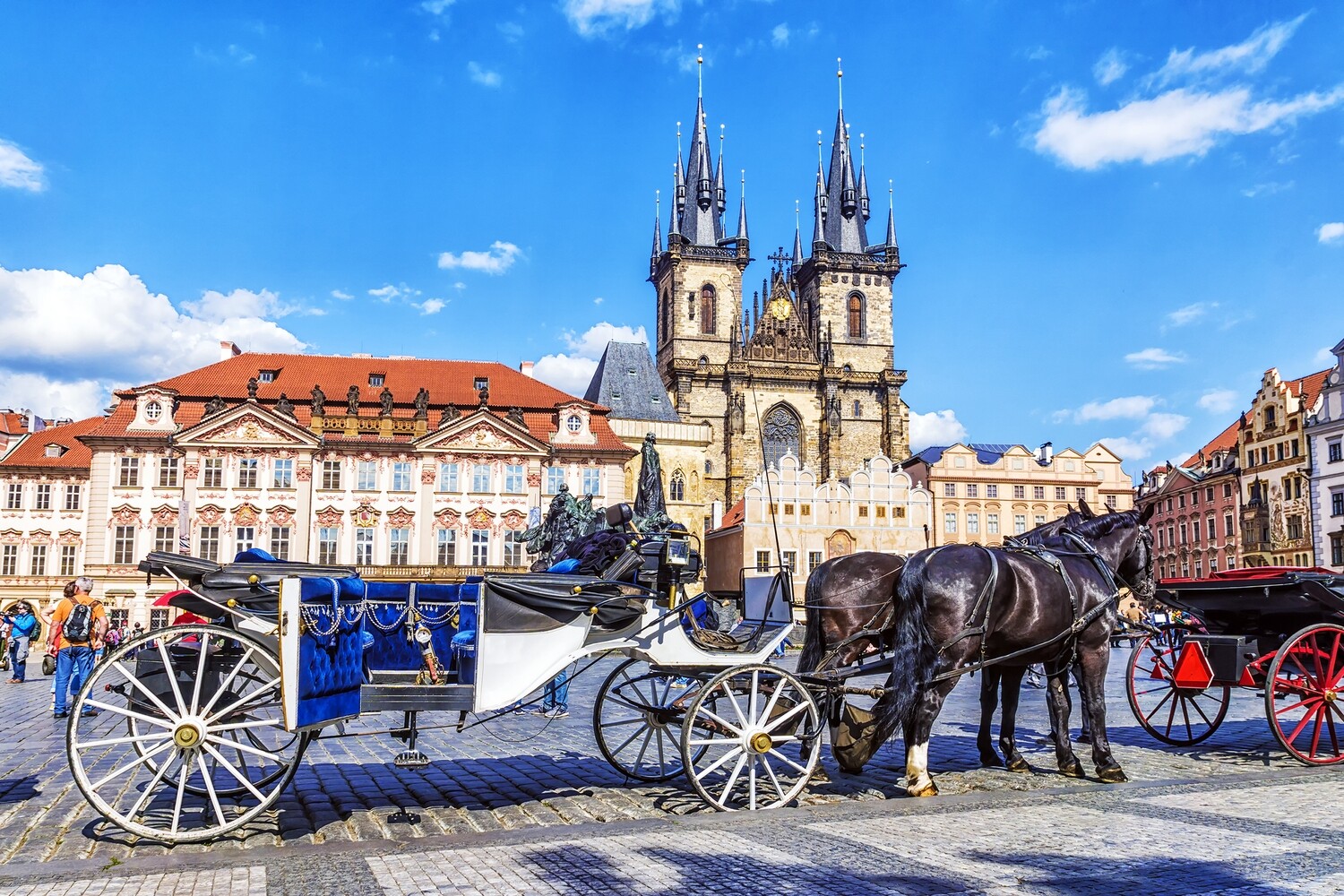
PRAGUE
Prague is home to a number of famous cultural attractions, many of which survived the destruction of 20th-century Europe. Main attractions include the Prague Castle, the Charles Bridge, Old Town Square, Astronomical Clock, the Jewish Quartier, Petrin Hill and Vyseharad. Since 1992 the historic centre of Prague has been included in the Unesco list of World Heritage Sites.
Prague Castle - an ancient symbol of the Czech State, the most significant Czechmonument and one of the most important cultural institutions in the CzechRepublic. Prague Castle was most likely founded in around 880 by Prince Bořivojof the Premyslid Dynasty (Přemyslovci). According to the Guinness Book of WorldRecords, Prague Castle is the largest coherent castle complex in the world,with an area of almost 70,000 m². A UNESCO World Heritage site, it consists ofa large-scale composition of palaces and ecclesiastical buildings of variousarchitectural styles, from the remains of Romanesque-style buildings from the10th century through Gothic modifications of the 14 th century. The famous Slovenian architect Josip Plečnik was responsible forextensive renovations in the time of the First Republic (1918-1938). Since theVelvet Revolution, Prague Castle has undergone significant and ongoing repairsand reconstructions.
Charles Bridge is a historic bridge that crosses the Vltava river in Prague, Czech Republic. Its construction started in 1357 under the auspices of King Charles IV, and finished in the beginning of the 15th century. The bridge replaced the old Judith Bridge built 1158–1172 that had been badly damaged by a flood in 1342. This new bridge was originally called Stone Bridge (Kamenný most) or Prague Bridge (Pražský most) but has been "Charles Bridge" since 1870. As the only means of crossing the river Vltava (Moldau) until 1841, Charles Bridge was the most important connection between Prague Castle and the city's Old Town and adjacent areas. This "solid-land" connection made Prague important as a trade route between Eastern and Western Europe.
AstronomicalClock - The mediaeval tower clock is located at the southern side of the Old TownHall Tower. When the clock strikes the hour (from 9.00 a.m. to 11.00 p.m.), theprocession of the Twelve Apostles sets in motion.
The Jewish Quarter (Josefov) in Prague is located between the Old Town Square and the Vltava River. Its torrid history dates from the 13th century, when Jewish people were ordered to vacate their disparate homes and settle in one area. The monuments even survived the Nazi occupation in the 20th century. Adolf Hitler himself decided to preserve the Jewish Quarter as a “Museum of an Extinct Race”. Indeed the Nazis gathered Jewish artefacts from other occupied countries, transporting them to Prague to form part of the museum.
Vyšehrad - According to ancient legends, Vyšehrad is oldest seat of Czech princes; in fact, the local settlement was established in the mid-10th century. Situated on a rocky promontory above the Vltava River, it offers stunning views of the city, and the park area holds hidden architectural treasures including the rare Romanesque Rotunda of St Martin, the neo-Gothic Church of St. Peter and Paul, the national cemetery Slavín, and the underground casements housing the some of the original Baroque statues from the Charles Bridge.
The Czechs are big beer drinkers and rank highly on the beer per capita ratings. Good news for the travellers – the chance to join the Pub Crawl.